

A Day in the Life of a Lead Auditor: How a Site Audit Actually Runs
What does a lead auditor's audit day look like hour by hour? From the opening meeting to the closing meeting: interviews, sampling, evidence gathering, and writing up nonconformities. A first-hand view from the field.
Eren İŞMAN · Lead Trainer — Exemplar Global Registered Training Provider
A lead auditor course teaches the audit process in theory. But a day in the life of a lead auditor feels different in the field. This article walks through a typical day of a third-party certification audit, hour by hour, from the opening meeting to the closing meeting — what the lead auditor decides, how they manage the team, and where the time actually goes.
Key Takeaways: the shape of an audit day
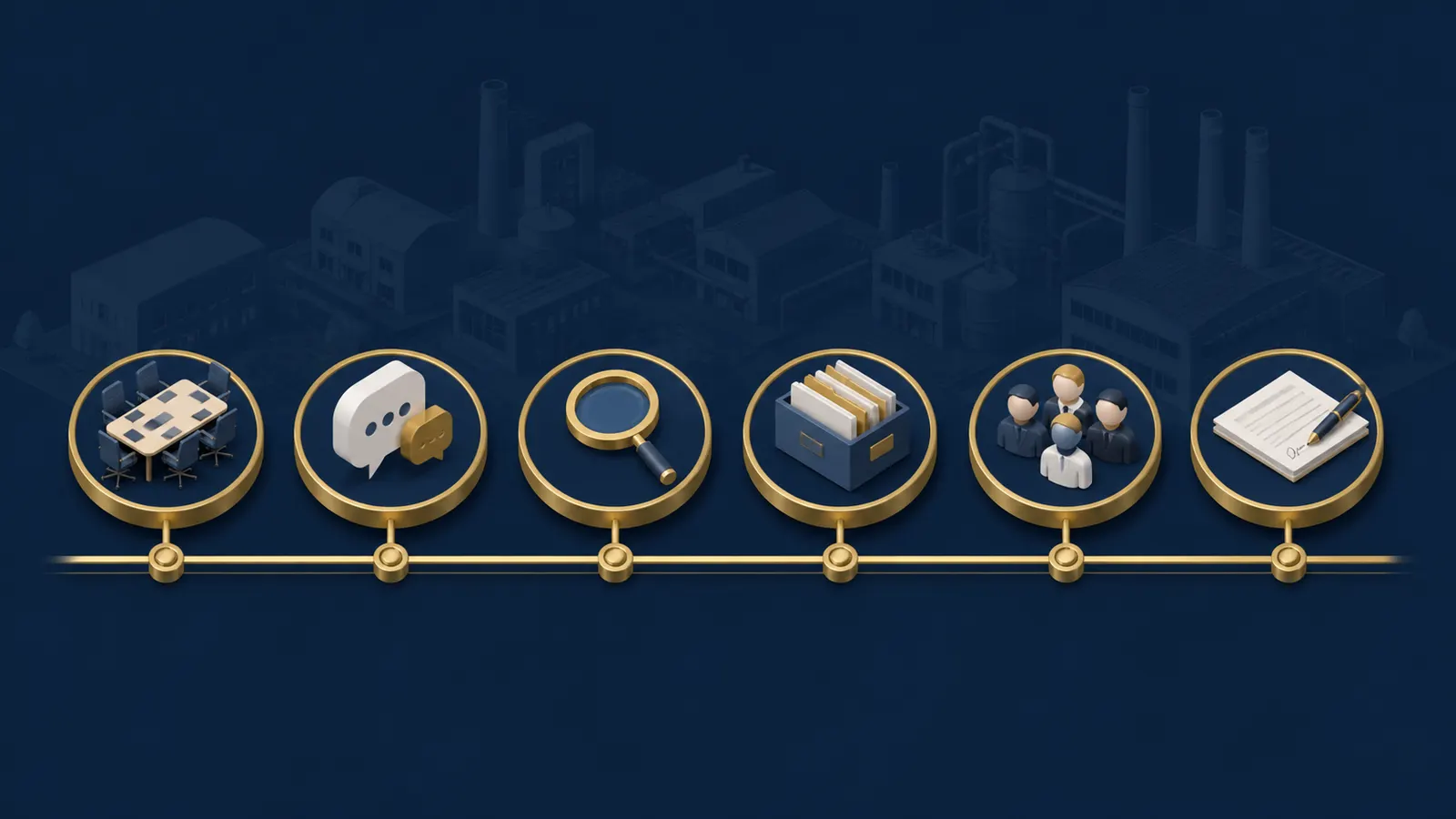
- The audit day follows the flow ISO 19011 defines: opening meeting → on-site activities (interviews, observation, record review, sampling) → team evaluation → closing meeting.
- The lead auditor's job is less about gathering evidence and more about managing time, scope, and the team; much of the day is spent adjusting the plan in real time.
- The moment candidates struggle with most is not spotting a finding, but turning it into a defensible nonconformity statement at the end of the day.
- A good audit day ends with a closing meeting that holds no surprises: the auditee should have heard every finding when it emerged, not for the first time at the end.
Before the audit: the preparation that finishes before the day starts
For a lead auditor, the "audit day" actually begins days earlier. Before the site visit, the lead auditor has completed:
- Document review: the management system manual, scope statement, previous audit reports, corrective action records, and process maps.
- The audit plan: which process is audited when, by whom, and with whom — an hourly schedule, sent to the auditee in advance.
- Team assignment: if more than one auditor is involved, the lead auditor allocates processes to team members by competence and identifies any need for a technical expert.
- Risk-based sampling decisions: because time is limited, the lead auditor decides in advance where to look, weighting the highest-risk areas.
09:00 — Opening meeting
The day starts with a short, structured opening meeting. The lead auditor runs it and confirms: the audit objective and scope, the criteria (the standard plus the organization's own documentation), the day's schedule, confidentiality and safety rules, the guide arrangement, and the time of the closing meeting. It usually takes 20–30 minutes.
Trainer's note: the real purpose of the opening meeting is not to inform, it is to set the tone. An audit is not an exam; it is an evidence-based evaluation. A lead auditor who makes that clear in the first minute works with a far more open and collaborative environment for the rest of the day.
09:30–12:30 — On-site activities
This is the busiest part of the day. The lead auditor and team gather objective evidence by interviewing process owners, observing activities, and reviewing records. A typical flow:
- Process interview (30–45 min): starts with "walk me through this process," then continues with open questions. The auditor compares the answer against the requirement of the standard and the organization's own procedure.
- Asking for evidence: every verbal statement should be backed by a record — a form, a log, a calibration certificate, a training record, meeting minutes.
- Sampling: the auditor reviews a representative sample, not every record. Sample selection and size are a matter of auditor judgement and are recorded in the report.
- Tracing: following a record forward (input to output) or backward (complaint to root cause) tests whether the system actually works.
- Note-taking: the auditor records the finding in enough detail to reconstruct it later — date, document number, person, observation.
Throughout, the lead auditor syncs briefly with team members: "Where are you? Are you on time? Do you need help?" If part of the scope is running longer than planned, the lead auditor rebalances the plan during the day.
12:30–13:15 — Lunch and team sync
Lunch is often not a real break; the lead auditor gathers the team, collects the morning's findings, identifies overlaps and gaps, and re-prioritizes the afternoon. This 15-minute sync is the key to a closing meeting without surprises.
13:15–16:00 — On-site activities (continued) and closing the gaps
In the afternoon the lead auditor focuses on the processes left unfinished in the morning and on the areas where a team member said "there's something here but I'm not sure." Two typical decisions get made here:
- Go deeper or move on? Is a symptom a one-off error or a systemic weakness? The lead auditor takes an additional sample to tell them apart.
- The weight of the finding. Is an unmet requirement a major nonconformity (part of the system failing / putting the certificate at risk), a minor nonconformity, or an opportunity for improvement?

16:00–17:00 — Team evaluation and writing nonconformities
Before the site closes, the team withdraws to a room and lays out all the findings. Here the lead auditor:
- Consolidates findings and merges duplicates.
- Turns each nonconformity into a three-part statement: the situation observed + the requirement not met (a clause of the standard or a procedure) + the objective evidence that supports it (document number, date, person).
- Finalizes the classification (major / minor / OFI).
- Rehearses with the team what will be said in the closing meeting.
Trainer's note: if an auditor writes "calibration records were disorganized," that is an impression, not a finding. The same finding becomes defensible written like this: "Contrary to ISO 14001 clause 7.1.5 and procedure QMS-PR-12, 3 of the 8 measuring devices reviewed (tag no. 114, 118, 132) were past their calibration date and still in use." The transformation candidates lose the most marks on — in the exam and on their first audits — is exactly this one.
17:00 — Closing meeting
The lead auditor runs the closing meeting: the overall audit result, the nonconformities found and their classification, the expected timeframe for corrective action, and the next step (report delivery, and the date of a follow-up audit if one is needed). In a well-run closing, the auditee hears none of the findings for the first time; each was discussed with the relevant process owner as it emerged.
After the audit: the report
The audit report is usually written within a few working days of the site day. The lead auditor is accountable for its completeness and consistency; they merge team members' findings into a single voice and document the scope, the sampling, and the limitations.
The real work of lead auditing
A day in the life of a lead auditor looks, from the outside, like reviewing records. But the core of the work is judgement and management: looking at the highest-risk areas in limited time, deciding whether a symptom is systemic, keeping the team locked on the objective, and turning a finding into a defensible statement. That is what separates a lead auditor from an auditor.
MEGADEMİ's lead auditor courses rehearse this day with simulated audits and role-play exercises. Browse the course catalogue.
Frequently Asked Questions
How many hours does an audit day last?
A typical site day is about 8 hours (09:00–17:00), but for the lead auditor the day extends by a few more hours with report writing. The total number of audit days is set by the organization's size and scope.
What does a lead auditor spend most of the audit on?
Managing time, scope, and the team rather than gathering evidence. The plan is almost always rebalanced during the day; the lead auditor continually decides where to go deeper and where to move on with a sample.
When does the auditee learn about the findings?
As they emerge. In a good audit the closing meeting holds no surprises; every nonconformity has already been discussed with the relevant process owner.
What is the difference between a major and a minor nonconformity?
A major nonconformity indicates that part of the system is not achieving its purpose or puts the certificate at risk. A minor nonconformity is an isolated deviation that does not threaten the system as a whole. Classification rests on auditor judgement and evidence.
Conclusion
A lead auditor's day follows the flow ISO 19011 defines: opening, on-site activities, team evaluation, closing. But what shapes the day is not the procedure — it is the lead auditor's decisions about where to look, what is systemic, and how to write the finding. Those decisions are learned through role-play in training and settle with experience on early audits.
Sources
- ISO 19011:2018 — Guidelines for auditing management systems (Clause 6: conducting an audit; opening/closing meeting, gathering evidence, sampling). Overview: https://goaudits.com/blog/iso-19011-audits/
- ISO 19011:2018 Clause 7 — Competence of auditors (additional team-leader competence). Commentary summary: https://preteshbiswas.com/2023/12/07/iso-190112018-clause-7-competence-and-evaluation-of-auditors/
The day flow and time split in this article are an indicative framework reflecting a typical third-party surveillance audit; real schedules vary with the organization's size, scope, and audit type.